Skip to content

Cooley Law School Hosts Former Tampa Bay Buccaneer During Sports and Entertainment Law Society Event

Cooley Law School Hosts Former Tampa Bay Buccaneer During Sports and Entertainment Law Society Event

TAMPA, Fla. — On March 25, Cooley Law School’s Sports & Entertainment Law Society hosted an event, “The Law Behind the Lights: Where Sports, Entertainment and Law Intersect,” at the Cooley Event Center on its Tampa campus, featuring Jimmy DuBose, a former NFL running back for the Tampa Bay Buccaneers. The event also featured, Shawuki Hilton, Esq., Cooley Law School alumnus and founding attorney of The Hilton Law Firm, and a poetry performance from Everkesia Taylor of I Am Poetry. “As a former professional athlete and present treasurer of the local National Football League Players Association, I am aware of amateur and professional athletes’ need for competent legal assistance,” said DuBose. “I was pleased to see the number of Cooley Law School students who have an interest in providing legal assistance to athletes in the future.” DuBose, an alumnus of the University of Florida Gators, was the first UF running back to rush for a 1,000 yards in a single season. He was named SEC Player of the Year in 1975, and selected to the Associated Press All-American team, and the Tampa Tribune All-Century Team in 1999. Additionally, DuBose was inducted into UF’s Hall of Fame in 1978 and the Sarasota High School Hall of Fame in 2018. He played four years for the Tampa Bay Buccaneers and became the first player in franchise history to rush for a hundred yards before getting injured and retiring from the NFL. Outside of football, DuBose worked in education for 22 years as a teacher, football coach, dean, and assistant principal in Hillsborough, Orange, and Pasco counties. He is currently the treasurer of the local chapter of the NFL Players Association leadership, where he has served in various capacities for over 20 years. “I’d like to say that it was an amazing event and I’m grateful for having been invited to participate,” said Hilton. “I look forward to future opportunities to work with SELS.” Hilton, who practices sports law, represents professional athletes within the Canadian Football League. Before graduating cum laude from Cooley, Hilton served as the justice of Phi Alpha Delta Law Fraternity International, vice president of entertainment of the Sports and Entertainment Law Society, and associate editor of the Cooley Journal of Practical and Clinical Law. He has served a diverse client base on matters related to business law, contract law, consumer protection, estate planning, intellectual property, and real estate. “Our goal was to bring together professionals from sports and the arts to give students a real, firsthand look at how law shapes each path — from NFL players to emerging artists building their dreams,” said Kimberly Ayala, SELS president. “It was an incredibly powerful experience, and if you weren’t there, you truly missed something special.” Cooley Law School’s Sports & Entertainment Law Society hosted an event, “The Law Behind the Lights: Where Sports, Entertainment and Law Intersect,” on March 25 at the Cooley Event Center on its Tampa campus. Pictured from left to right: Daniel Podboy- Navarro, Cooley Law School SELS vice president; Jim Hicks, SELS faculty advisor; Kimberly Ayala, SELS president; Shawuki Hilton; Renalia DuBose, Cooley professor; Jimmy DuBose, former NFL player; Everkesia; John Johnson, SELS public relations; and Giani Villalba, SELS secretary.

Read More
  • Cooley Law School Student Organization Hosts Juneteenth Freedom Celebration

    Cooley Law School Student Organization Hosts Juneteenth Freedom Celebration

    Cooley Law School’s Black Law Students Association hosted Juneteenth Freedom on June 13, featuring Hillsborough County Judge Daryl Manning as the honorary speaker. During the event, Manning spoke about becoming part of the Florida Bar Association and remaining a member. “You need to begin your application to the Florida Bar now because it typically takes about six months for the initial review,” he told the law students. “If your application is incomplete or you have character and fitness issues, it will take longer.” Manning, a native of Queens, New York, has been a Hillsborough County judge in Tampa since 2015. He presides over a drug court division and a unified family court division. Previously, Manning was a practicing and supervising attorney in the Tampa Office of the Florida Attorney General for 16 years, where he appeared in state and federal trial and appellate courts. “Three of the most difficult bar examinations are given in Florida, California and New York,” Manning said during the evening. “You need to work hard if you intend to practice in any state, but especially these three.” He added: “Good character and fitness are crucial for the practice of law. Don’t spend the time and money to become a lawyer and fail to maintain your license. Honesty and integrity are critical traits for lawyers to possess.” Manning obtained a master of laws degree from the Army Judge Advocate Legal Center and School at the University of Virginia in Charlottesville, Virginia; Juris Doctor from St. John’s University School of Law in Queens; and his bachelor of arts degree from the University of South Carolina, in Columbia, South Carolina. He was a Judge Advocate (JAG) in the U.S. Army and served several tours in support of the Global War on Terrorism in Iraq, Afghanistan, Saudi Arabia and Kuwait before retiring as a lieutenant colonel in 2015 after 30 years on active duty and in the reserves. Jun 15 2023

  • WMU-Cooley Law School Hosts Law Day Celebration

    WMU-Cooley Law School Hosts Law Day Celebration

    On Monday, May 1, WMU-Cooley Law School celebrated Law Day 2023 with a virtual event, featuring Michigan Supreme Court Chief Justice Elizabeth T. Clement. Clement, who was the keynote speaker for WMU-Cooley’s event, shared her perspective on this year’s Law Day theme, “Cornerstones of Democracy: Civics, Civility, and Collaboration,” and its importance in the legal community. “When you’re talking about democracy, these are the three pillars – the foundation of democracy,” said Clement. “The key message I want you to take away from this discussion today and Law Day is that we can’t do any of this work without each and every one of you. We need all the stakeholders in Michigan’s justice system, including law students, future lawyers, and leaders, to be engaged, contributing your experiences, expertise and ideas. Whether it’s access to justice, data transparency or juvenile justice, my goal is for Michigan to be a national leader, and we need you to help us make that vision a reality.” Clement spoke about how each pillar – civics, civility and collaboration – play an important role in today’s judicial system. Pictured: Justice Elizabeth Clement “Civics is about how we inform and educate Michigan residents about their constitutional rights, as well as the resources courts have to offer for everyone that interacts with the judiciary system, and the duties and responsibilities that go along with those rights,” she said. When sharing about civility, Clement explained that civility is defined as a formal politeness or courtesy – treating one another with dignity and respect. “For me, this applies to every aspect of court operations because courts always need to focus on treating the people we serve with dignity and respect,” she said. “People come to court on the most difficult days of their lives. They deserve not just a fair playing field, but one where they are welcomed, valued and supported. I really feel that civility in the judiciary system starts at the very top. We have worked very, very hard to improve the civility, not just on our own court, but in all of the courts around the state of Michigan.” Clement said she looks at collaboration as the act of working together toward a common purpose. “In the judiciary, we definitely know how to lead, but we also understand that we accomplish so much more when we collaborate with stakeholders,” she said. “We’re really trying to be thoughtful that what we’re here to do is to serve the public, and the best way to do that is to collaborate with everyone that’s involved in the judicial branch and make sure we’re responsive to what’s being expected and asked of us.” On Law Day, students and staff at WMU-Cooley will join others throughout the country in rebuilding trust in the nation’s institutions, respect for one another, and demonstrate that WMU-Cooley is committed to being an agent for positive change in communities and the legal profession. “Law Day is a national day set aside to celebrate the rule of law,” said WMU-Cooley Law School Associate Dean Tonya Krause-Phelan. “It provides us with the opportunity to understand how law and the legal process protect our liberty, strive to achieve justice and contribute to the freedoms that all Americans share.” May 05 2023

  • Cooley Innocence Project and Exoneree Gilbert Poole to Participate in Riverwalk Theatre Talkback with 'Exonerated' Cast

    Cooley Innocence Project and Exoneree Gilbert Poole to Participate in Riverwalk Theatre Talkback with 'Exonerated' Cast

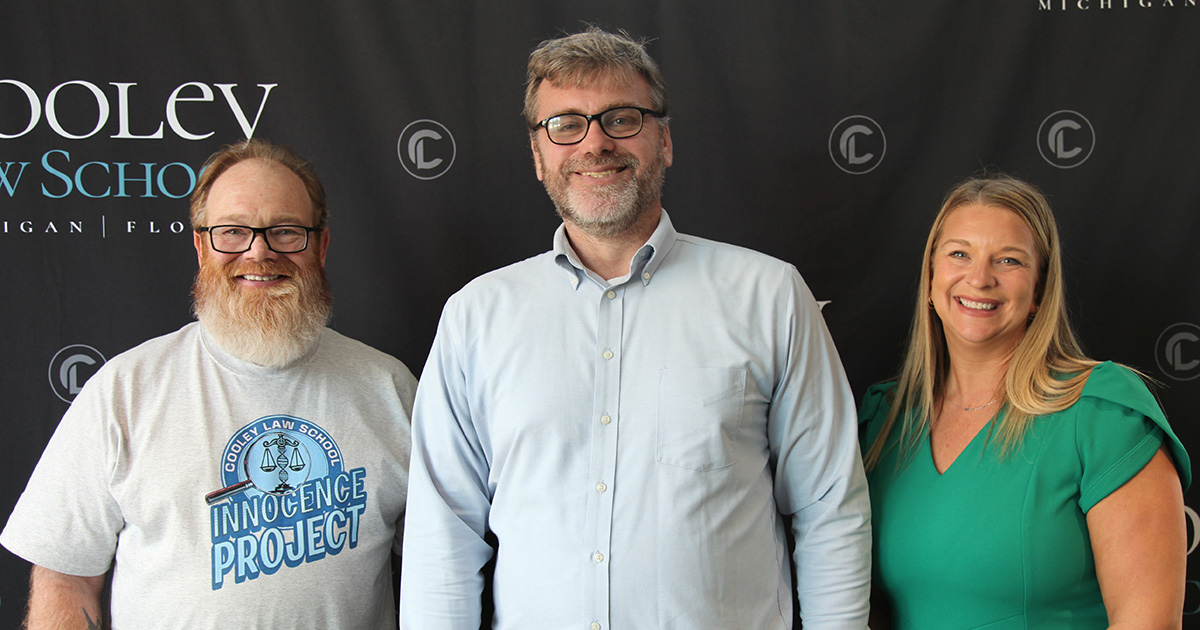
    Cooley Law School’s Innocence Project will participate in Riverwalk Theatre’s Talkback events throughout the theater’s production of “The Exonerated.” Tracey Brame will lead the talkback discussion on Saturday, Feb. 17, while Marla Mitchell-Cichon will lead the discussion on Saturday, Feb. 24. Brame is the director of Cooley’s Innocence Project and associate dean of experiential learning and practice preparation, while Mitchell-Cichon is a distinguished professor emeritus, and counsel to the Cooley Law School Innocence Project. “The Exonerated,” by Jessica Blank and Erik Jensen, tells the stories of five men and a woman, all of whom were wrongly sentenced to death for murders that they did not commit. Between them, they spent over 100 years on death row watching their fellow inmates die in the electric chair, while awaiting their own imminent deaths. The show is directed by Alan Greenberg and runs Feb. 15-18 and 22-25 at Riverwalk Theatre, 228 Museum Dr., Lansing. Brame (right) and Mitchell-Cichon (left) will lead the post-performance Talkback discussion on Feb. 17 and Feb. 24. The show will start at 8 p.m., with the talkback at about 9:30 and conclude at or shortly before 10 p.m. Cooley Innocence Project exoneree Gilbert Poole (center), who spent 32 years behind bars for a crime he did not commit, will join the discussions for both performances. David Williams (back row) was a past student and attorney with the Cooley Innocence Project. The Cooley Innocence Project is part of the Innocence Network which has been credited with the release of over 375 wrongfully convicted prisoners, mainly through the use of DNA testing. It is the only post-conviction DNA innocence organization in Michigan. Since its inception, the office has screened over 6,000 cases and is responsible for the exoneration of nine individuals: Kenneth Wyniemko (2003), Nathaniel Hatchett (2008), Donya Davis (2014), LeDura Watkins (2017), Kenneth Nixon (2021), Gilbert Poole (2021), Corey Quentin McCall (2021), George DeJesus (2022), and most recently, Louis Wright (2023), who spent 35 year wrongfully imprisoned. Additionally, the Cooley Innocence Project also helped to exonerate Lacino Hamilton, Ramon Ward, Terance Calhoun, and Crystal Mulherin. About Cooley Law School: Cooley Law School was founded on a mission of equal access to a legal education and offers admission to a diverse group of qualified applicants across the country. Since the law school's founding in 1972, Cooley has provided a modern legal education to more than 21,000 graduates, teaching the practical skills necessary for a seamless transition from academia to the real world. An independent, non-profit law school, accredited by both the American Bar Association and the Higher Learning Commission of the North Central Association of Colleges and Schools, Cooley holds classes year-round at its Michigan and Florida campuses. Feb 09 2024

  • Cooley Law School's International Law Moot Court Team Places in the Top 11 During Regional Competition

    Cooley Law School's International Law Moot Court Team Places in the Top 11 During Regional Competition

    A team of Cooley Law School students competed in February against 36 other U.S. law school teams at the West Regional of the Philip C. Jessup International Law Moot Court Competition in Portland, Oregon. On the strength of a 3-1 record in the preliminary oral argument rounds, the team qualified for the advanced rounds, earning a top 11 ranking at the competition. The Cooley team also earned a top ten award for the quality of its written pleadings, taking home the award for seventh best Memorials. The Jessup competition simulates a fictional case before the International Court of Justice on cutting edge issues of international law. This year’s Jessup problem involved the right of consular access for detained individuals, citizenship and the problem of statelessness, and the authority of the United Nations Security Council. Cooley’s team included Adriana Burga, Nicholas Davis, Carter Lewis, Norelle Miranda, and Frances Silney-Bah. The team was coached by Cooley Law School Professors Brad Charles and Dave Finnegan. “The team performed at an elite level,” said Professor Finnegan, who is a coach for the team. “I am particularly proud of the award the team received for their written memorials, reflecting the strength of their legal research and writing skills.” The Jessup competition is the largest inter-school moot court competition in the world. This year, around 700 law schools in 100 countries and territories participated in the competition. The International Law Students Association administers the Jessup competition each year. Cooley Law School’s International Moot Court team recently advanced to the octa-final round after compiling a 3-1 record in the preliminary rounds at the Jessup International Law Moot Court competition held in Portland, Oregon. Cooley Law School’s team included (L-R) Carter Lewis, Frances Silney-Bah, Norelle Miranda, Adriana Burga and Nicholas Davis. Mar 20 2024

  • Cooley Law School's Tampa Bay Campus Hosted an All-Women U.S. Citizenship Naturalization Ceremony

    Cooley Law School's Tampa Bay Campus Hosted an All-Women U.S. Citizenship Naturalization Ceremony

    In celebration of National Women’s History Month, the U.S. Citizenship and Immigration Services held an all-women naturalization ceremony at Cooley Law School’s Tampa Bay campus on Friday, March 1. The ceremony included the Oath of Allegiance, the final step to citizenship for the 55 candidates originating from 30 different countries. Cooley Assistant Dean Katherine Gustafson provided opening remarks before U.S. Magistrate Judge Catherine McEwen administered the oath. Presenting the Naturalization Certificates was Supervisory Immigration Services Officer Gerald Evans. “I think it’s so appropriate that we have this ceremony during National Women's History month,” said Gustafson. “Today is the first day of that month, and this month is dedicated to amplifying women’s voices, to honor the past, to inform the present, and to inspire the future. The strength of the women in this room sitting in front of us right now inspires all of us. In a lot of ways, I think the fact that you are a Naturalized citizen gives your citizenship a little extra meaning. You’re Americans by choice, not by accident. You had to earn the right to be here today.” When addressing the applicants Judge McEwen and Gustafson both spoke about the opportunities of becoming a citizen and their family’s personal experiences with immigration. To honor the beginning of National Women’s History month, Judge McEwen reiterated that the women are making history today. “You 55 women are making history in your own right today,” said Judge McEwen. “From today on, each one of you ladies will enjoy every right, every liberty, every opportunity that America gives to all of its citizens.” Mar 01 2024

  • Cooley Law School Hosts Expungement Fair in Partnership with Michigan Attorney General's Office

    Cooley Law School Hosts Expungement Fair in Partnership with Michigan Attorney General's Office

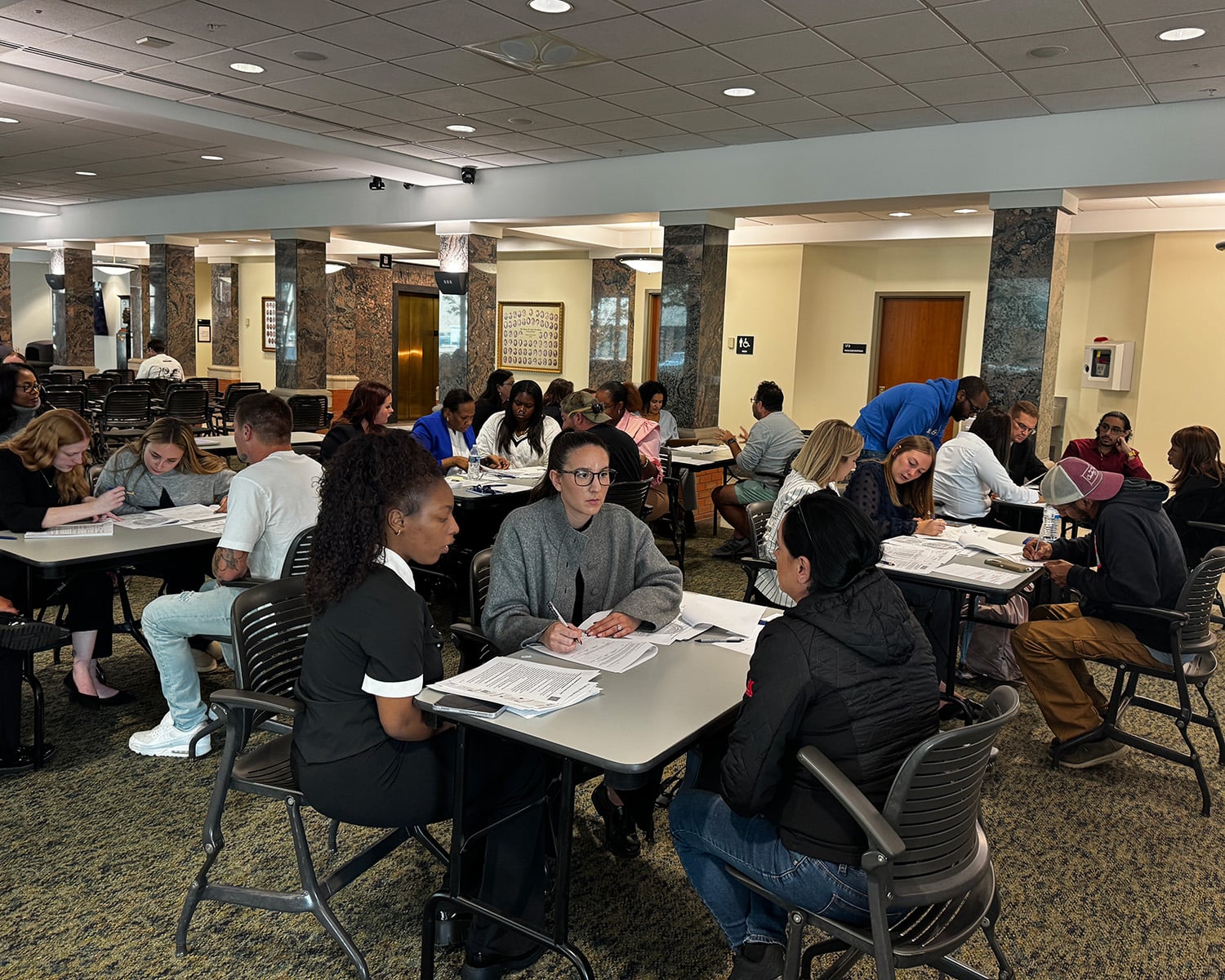
    Cooley Law School, in collaboration with the Michigan Attorney General’s Office and Safe & Just Michigan, held an expungement fair at the law school’s Lansing campus on Friday, Oct. 27. During the fair, volunteer attorneys and law students under the supervision of licensed attorneys assisted 91 guests with their expungement paperwork. Expungement removes arrests and convictions from a person’s public criminal record. Criminal offenses that have been expunged are no longer accessible to employers or landlords. Michigan law has always allowed for expungements, but the “Clean Slate” legislation enacted in 2020 made more individuals and offenses eligible for expungement. Under the new law, individuals with up to three expungement-eligible felonies and any number of misdemeanors can have their records expunged. Certain traffic violations and first-time operating while intoxicated offenses can be expunged. Additionally, misdemeanor marijuana convictions that would not have been considered crimes after recreational marijuana was legalized in Michigan can be expunged. Cooley Law School, in collaboration with the Michigan Attorney General’s Office and Safe & Just Michigan, held an expungement fair at the law school’s Lansing campus on Friday, Oct. 27. During the fair, volunteer attorneys and law students under the supervision of licensed attorneys assisted 91 guests with their expungement paperwork. Oct 31 2023

  • Cooley Sixty Plus, Elderlaw Clinic to Partipate in AARP Event on Financial Security for Women

    Cooley Sixty Plus, Elderlaw Clinic to Partipate in AARP Event on Financial Security for Women

    Cooley Law School Sixty Plus, Elderlaw Clinic Director Dustin S. Foster will present on financial security for women during a “MI Sisters & Friends: Show Me the Money!” virtual event hosted by AARP on March 7. The March 7th event is from 11 a.m. to 12 p.m. ET During the event, Foster will share information about wills and trusts, powers of attorney (medical and financial), non-probate transfers, financial exploitation, the importance of savings, and how to save. Dr. Sonya Gunnings-Moton of Michigan State University College of Education will be the host of the event, and Therese Bacon, financial educator with MSU Federal Credit Union, will share tips on financials savings. Attendees will have the opportunity to ask questions following the presentations. “Sixty Plus provides educational presentations to communities on estate-planning topics,” said Foster. “Partnering with AARP for this event is an opportunity to support women who want to know more about estate planning and financial security as they age.” GO HERE TO REGISTER FOR THE EVENT The Sixty Plus, Inc., Elderlaw Clinic (Sixty Plus) is Cooley Law School’s live-client estate planning clinic. The Sixty Plus clinical experience enables students, called student attorneys, to interview, counsel, represent and draft estate planning documents for actual clients, all of whom are age 60 and older. Student attorneys, who are closely supervised by the clinical faculty, proceed on behalf of clients drafting a variety of estate planning documents, including wills, power of attorney for health care, durable power of attorney for finances, and enhanced life estate deeds. Feb 15 2024

  • Cooley Law School Hosts Judge Kwamé Rowe

    Cooley Law School Hosts Judge Kwamé Rowe

    Cooley Law School’s Criminal Law Society and Black Law Student Association joined the Organization of Women Law Students to host an event on July 15, featuring Cooley graduate, the Hon. Kwamé L. Rowe. Judge Rowe, the second African American male and the youngest judge to serve on the Sixth Circuit Court bench, spoke about his life's journey as an attorney and how he came to be the youngest judge in Michigan. Donations from the event were made to the Oakland County Bar Association Foundation's DEI Scholarship Fund. Jul 26 2023

  • WMU-Cooley Law School Holds Black History Month Discussion

    WMU-Cooley Law School Holds Black History Month Discussion

    Wayne County, Michigan, Circuit Court Administrator Zenell Brown, Esq., led WMU-Cooley Law School’s Black History Month virtual discussion on Thursday, Feb. 23, as part of the law school’s Community Conversation series. The author of Coffee and Conversations: Inclusion and Belonging, Brown is one of the legal profession’s most sought-out speakers and trainers of leadership and inclusion. She is a champion of justice for all through diversity, equity, and inclusion, and melds her court leadership, crucial conversation, dispute resolution skills, and diversity skills. During the conversation, Brown spoke about her time working in the courts and some of the people she has met, learned about, and the history of black contributions in the court system. She recently wrote an article about black individuals who were leaders in the court system, which was published in Michigan Lawyers Weekly. While sharing about Macon Bolling Allen, who is believed to have been the first African American to become an attorney, Brown said, “he was not accepted as a lawyer. He actually had to leave where he passed the bar and made to go practice elsewhere.” From Allen’s experiences as a lawyer, Brown asked if today “are we really a welcoming practice to diverse populations and how do we make sure that we do have adequate pipelines and are building bridges, so those who don’t look traditionally what we think lawyers should look like have access and opportunity to practice law?” Speaking about Charlotte E. Ray, who was the first black American woman lawyer, Brown said that Ray “enrolled at Howard University under the name C.E. Ray so nobody would know her gender.” While sharing some of Ray’s accomplishments, Brown said, “when we think about suffrage we don’t think about black women in the role they play. Start asking yourselves, how do we lift each other up.” While working in the courts, Brown saw the merger of the Detroit Recorders Court, which handled crimes that happened inside the city of Detroit with the Third Circuit Court in 1998. “Because of the demographics in Detroit, you had a lot of judges who were in recorders court who were African American. When the two courts merged, those judges not only had to run for election in the city of Detroit, but they had to run for the election county wide,” said Brown. “Over the years you would see the percentage of African American judges sort of dwindle once that merger came about.” Brown noted that she was fortunate to work with chief judges who noticed the lack of African American representation on the bench was an issue. “They would send information to the governor and say ‘are you paying attention to this as you make appointments that our bench needs to represent the community that we’re serving.’” As the leader of Michigan’s Third Circuit Court administrative operations and member of National Association of Women Judges, Brown has 20 years of experience and a daily practice in the arts of court leadership and inclusion. In 2022, Brown was awarded the American Bar Association’s Robert B. Yegge Award for outstanding contribution in judicial administration, and the National Association of Court Management’s Perkins Award for consistently going above and beyond the call of duty to make behind-the-scenes contributions in court administration. The full conversation with Brown can viewed on WMU-Cooley’s YouTube channel. WMU-Cooley’s Community Conversation series events take a deep dive into the most current topics impacting society and world. Feb 27 2023