
Skip to content

Morgan Prybys Builds a Path From Paralegal to Attorney

Morgan Prybys Builds a Path From Paralegal to Attorney

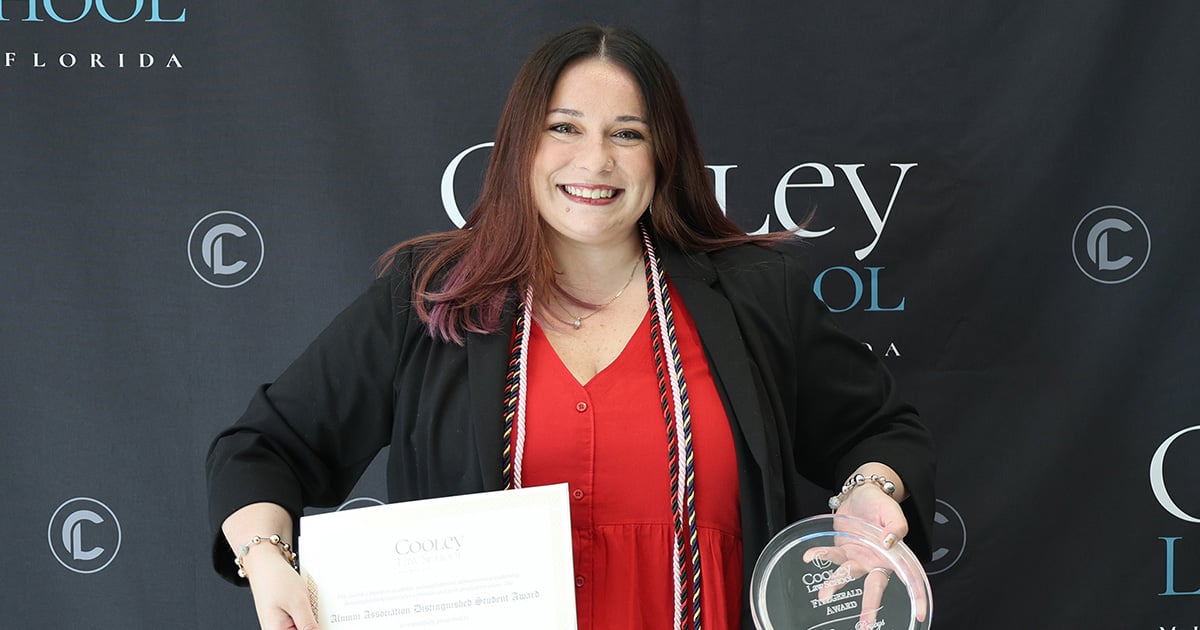
Recent Cooley Law School graduate Morgan Prybys is turning a longtime dream of becoming a lawyer into a career focused on helping others. Prybys, who began her professional journey working in security before becoming a paralegal, was recently recognized with the Cooley Alumni Association Distinguished Student Award at the law school’s Honors Convocation. The award recognized her academic journey, involvement and commitment to supporting those around her. During her time at Cooley, Prybys was involved with several student organizations and served as a teaching assistant. She also gained hands-on experience through Cooley’s SixtyPlus ElderLaw Clinic, building on her interest in estate planning and elder law. Her legal interests also include compliance, an area in which she earned a Certificate of Merit. Her journey from doubting whether law school was possible to earning her J.D. and receiving recognition for her accomplishments reflects the persistence and growth that shaped her legal education. Read more about Morgan Prybys and her journey in the Legal News.

Read More
  • Showcase Your Scholarship, Part Two: Google Scholar Profiles and Other Platforms
    Showcase Your Scholarship, Part Two: Google Scholar Profiles and Other Platforms

    Showcase Your Scholarship, Part Two: Google Scholar Profiles and Other Platforms

    Part One: Use SSRN To Archive Articles explains how to use the Social Science Research Network (SSRN) to create an online archive of your articles. A decade after SSRN was founded in 1994, Google launched a similar platform, Google Scholar (GS), and later added profiles. GS profiles too can be used to create an online archive to display and preserve publications.


  • Showcase Your Scholarship, Part One: Use SSRN to Archive Articles
    Showcase Your Scholarship, Part One: Use SSRN to Archive Articles

    Showcase Your Scholarship, Part One: Use SSRN to Archive Articles

    An earlier post suggested ways to maximize the impact of your scholarship through spin-off articles.This three-part post identifies another way to showcase your scholarship: establishing a digital archive to display and preserve your publications, including self-published ones.

  • Homeland & National Security Law Review Symposium: Drone Concerns?
    Homeland & National Security Law Review Symposium: Drone Concerns?

    Homeland & National Security Law Review Symposium: Drone Concerns?

    Do you have questions about drones and how they may impact your safety and security? Take a deep-dive into drones, their social impact, and the legal rules surrounding Small Unmanned Aircraft Systems (sUAS) during this timely and critically important upcoming virtual event.

  • Brittany Lindsay: COVID-19 Hero of Tampa Bay
    Brittany Lindsay: COVID-19 Hero of Tampa Bay

    Brittany Lindsay: COVID-19 Hero of Tampa Bay

    Tampa Mayor Jane Castor may have named Cooley student Brittany Lindsay a COVID-19 Hero of Tampa Bay, but her hero status started well before 2020. In March of 2020, Lindsay was a Senior Program Director at the local YMCA supervising the Office of Youth Development. She was responsible for essential workers’ children. When daycare shut down, it was her immediate responsibility to make all daycare options safe for the children of essential workers, like police, firefighters, and those in the military. In essence, Lindsay became an essential worker tasked to help pave the way for essential workers and their families.

  • Adjunct Law Professors: Blessing or Curse?
    Adjunct Law Professors: Blessing or Curse?

    Adjunct Law Professors: Blessing or Curse?

    From its earliest days, Cooley Law School has employed the services of adjunct (part-time) professors. The faculty members hired to teach the very first entering class in 1973 were all part-timers. They consisted of two lawyers, an appellate judge, and a former prosecuting attorney.

  • Why Writing Well is Essential to Your Legal Career
    Why Writing Well is Essential to Your Legal Career

    Why Writing Well is Essential to Your Legal Career

    Writing is a necessary evil to some and a welcome respite to others. But whether you love it or hate it, lawyers spend much of their time writing, and writing well is important to success as a lawyer. Cooley understood these two facts from the start, which is why Cooley now has a nationally recognized research and writing program. Designed to teach students plain-language writing and techniques that will serve them throughout their careers, the program has raised the legal-writing bar nationwide.

  • Cooley Law School Grad Olu Ben-Shidah: Stay Focused and Fight for your Clients
    Cooley Law School Grad Olu Ben-Shidah: Stay Focused and Fight for your Clients

    Cooley Law School Grad Olu Ben-Shidah: Stay Focused and Fight for your Clients

    “Calm” is not a word that typically springs to mind when thinking about the practice of law – particularly criminal law. From stressed attorneys to frantic defendants, looming deadlines, over-crowded trial calendars, and high-stakes courtroom drama, “calm” just isn’t an adjective that typically gets put into play in the legal arena.

  • Guide to Good Writing; Get Specific!
    Guide to Good Writing; Get Specific!

    Guide to Good Writing; Get Specific!

    Strunk & White’s classic guide to good writing, The Elements of Style, urges writers to use definite, specific, and concrete language. “Prefer the specific to the general, the definite to the vague, the concrete to the abstract.” The goal is to write “with such accuracy and vigor that the reader, in imagination, can project himself into the scene.”

  • Vaccines. Masks. Mandates and the law. Cooley Experts Weigh in.
    Vaccines. Masks. Mandates and the law. Cooley Experts Weigh in.

    Vaccines. Masks. Mandates and the law. Cooley Experts Weigh in.

    Despite the apparent confusion and divide on the topic of vaccines, masks, and mandates, Cooley professors are very clear about what the law says, and what is allowed, not allowed, and why.