Skip to content

Aimee Lorencz: Cooley Graduate Builds Career Path in Criminal Law

Aimee Lorencz: Cooley Graduate Builds Career Path in Criminal Law

Recent Cooley Law School graduate Aimee Lorencz is turning years of professional experience and a passion for justice into a future career in criminal law. In a feature published by Legal News, Lorencz reflects on her journey from working as a correctional officer and CPS investigator to earning her law degree while balancing family, work, and leadership responsibilities. As a weekend/blended student, Lorencz immersed herself in hands-on learning opportunities including externships, moot court competitions, the Cooley Innocence Project, and student leadership roles. Her experiences strengthened her passion for criminal law, ethics, and advocacy. Read more about Aimee's story here: https://legalnews.com/Home/Articles?DataId=1606383.

Read More
  • Associate Dean and Professor Tracey Brame Featured on WGVU's Powerful Women: Let's Talk Podcast
    Associate Dean and Professor Tracey Brame Featured on WGVU's Powerful Women: Let's Talk Podcast

    Associate Dean and Professor Tracey Brame Featured on WGVU's Powerful Women: Let's Talk Podcast

    Tracey Brame, Associate Dean of Experiential Learning and Practice Preparation at Cooley Law School, was recently featured on WGVU's Powerful Women: Let's Talk podcast. A passionate legal advocate and educator, Brame shared her journey, commitment to justice, and the impact of her work. From her time at Legal Aid of Western Michigan to leading the Cooley Innocence Project, Brame has dedicated her life to advocating for justice for individuals and within legal systems. Her recognition as Michigan Lawyers Weekly's 2020 Lawyer of the Year reflects her deep commitment to public service. You can listen to the episode below or find it on Apple Podcasts, Spotify, NPR One, or anywhere else you listen to podcasts.


  • Professor Emeritus Gerald Fisher Provides Legal Analysis on Michigan Legislature's Dispute (Law360 & Detroit Free Press)
    Professor Emeritus Gerald Fisher Provides Legal Analysis on Michigan Legislature's Dispute (Law360 & Detroit Free Press)

    Professor Emeritus Gerald Fisher Provides Legal Analysis on Michigan Legislature's Dispute (Law360 & Detroit Free Press)

    Professor Emeritus Gerald Fisher was recently featured in the Detroit Free Press and Law360. He offered expert insight into a dispute over bills passed by the Michigan Legislature last year but not presented to the governor for consideration. A state judge recently ruled that the House should have presented the legislation. At Cooley, Professor Fisher taught Property, Secured Transactions, Constitutional Law, Zoning and Land Use Law, and State and Local Government Law. He also served as general counsel for cities, villages, and townships in southeast Michigan and as special counsel for governmental entities throughout Michigan. He appeared on 21 occasions in cases presented to the Michigan Supreme Court. To learn more about the legal complexities of this issue, read the full articles here:

  • Professor Mark Dotson Offers Insight on Detroit Water Main Break Legalities (Detroit Free Press)
    Professor Mark Dotson Offers Insight on Detroit Water Main Break Legalities (Detroit Free Press)

    Professor Mark Dotson Offers Insight on Detroit Water Main Break Legalities (Detroit Free Press)

    In a recent Detroit Free Press article, Professor Mark Dotson provided an expert analysis of the legal complexities arising from a water main break in Detroit. The incident caused extensive property damage, leading to questions about a liability waiver the city asked residents to sign. Professor Dotson noted that the city's primary concern is securing legal access to affected properties before conducting repairs. His main message for residents was: "Regardless of what the city is doing, regardless of requirements of the waiver, they need to notify their insurance company." He said they should do it now. Professor Dotson's expertise offers valuable guidance to Detroit residents navigating the legal aftermath of the water main break, highlighting the intersection of law and public infrastructure management. For a more in-depth understanding of Professor Dotson's analysis and the legal considerations surrounding this incident, read the full article: "Detroit asking water main flood victims to sign a waiver. We had 2 lawyers take a look."

  • Separation of Powers, the “Unitary” Executive, and the Removal Power of the President
    Separation of Powers, the “Unitary” Executive, and the Removal Power of the President

    Separation of Powers, the “Unitary” Executive, and the Removal Power of the President

    In Humphrey's Executor v. United States,[1] the Supreme Court of the United States ruled that a statutory restriction that provided a for-cause limitation on the removal of a Federal Trade Commission member was constitutional. The Federal Trade Commission Act limited the power of the President to remove a Commissioner to “inefficiency, neglect of duty, or malfeasance in office.”[2] The Court found that the statutory provision restricted the President’s removal power to those causes. It distinguished the recent decision of the same Court in Myers v. United States,[3] finding that the federal officer removed in Myers–a postmaster–was an executive officer restricted to the performance of executive functions, while the FTC Commissioner removed in Humphrey’s Executor acted in a quasi-legislative and quasi-judicial manner, and was not a purely executive officer. The Court held that the Commissioner could only be removed by the President for the causes listed in the Act. The limiting provision was constitutional.

  • The Constitution’s Limited Commitment to Separation of Powers
    The Constitution’s Limited Commitment to Separation of Powers

    The Constitution’s Limited Commitment to Separation of Powers

    About the Author: Don LeDuc is the retired president and dean of Cooley Law School. His book, Michigan Administrative Law, is revised and published annually by the West Group. He is a member of Scribes, the American Society of Writers on Legal Subjects, and received the Golden Pen Award from the Legal Writing Institute. This article is part of a multi-part series discussing the meaning of the U.S. Constitution's words.

  • Professor Mark Cooney Weighs in on Michigan Supreme Court's Political Shift (Bloomberg Law)
    Professor Mark Cooney Weighs in on Michigan Supreme Court's Political Shift (Bloomberg Law)

    Professor Mark Cooney Weighs in on Michigan Supreme Court's Political Shift (Bloomberg Law)

    Professor Mark Cooney recently shared his legal expertise in a Bloomberg Law article examining the impact of Michigan Supreme Court Chief Justice Elizabeth Clement’s decision to step down. Professor Cooney discussed how the court’s leftward shift is part of a swing he's noticed over nearly a decade. Professor Cooney’s insights provide critical perspective on how court composition influences legal outcomes. To read the full article and Professor Cooney’s analysis, visit "Michigan Chief Justice's Exit Fortifies Court's Leftward Swing."

  • Professor Jeffrey Swartz provides legal analysis of NYC Mayor Eric Adams' case (CNN Newsroom)
    Professor Jeffrey Swartz provides legal analysis of NYC Mayor Eric Adams' case (CNN Newsroom)

    Professor Jeffrey Swartz provides legal analysis of NYC Mayor Eric Adams' case (CNN Newsroom)

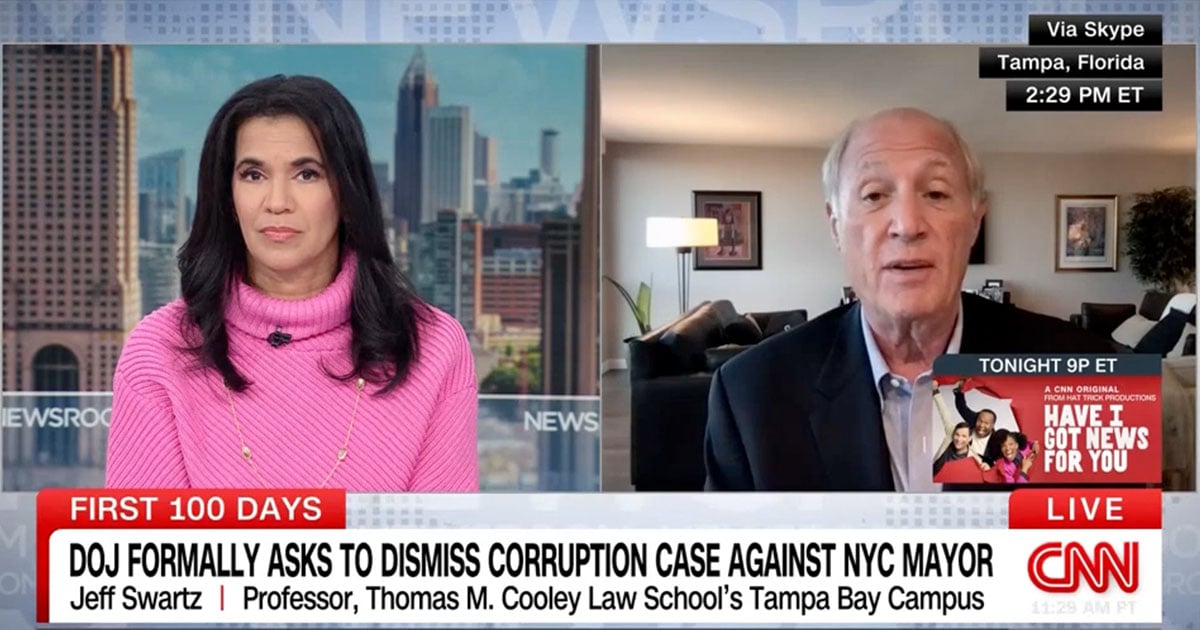
    Professor Jeffrey Swartz recently appeared on CNN Newsroom with Fredricka Whitfield to provide legal analysis on the Justice Department's decision to drop corruption charges against New York City Mayor Eric Adams. Professor Swartz has made numerous appearances on national and local television, providing expert commentary.

  • The New President and the Constitution
    The New President and the Constitution

    The New President and the Constitution

    After a national election that chose a new President, an election that took place in a closely divided nation, our new President has unleashed a continuing outpouring of initiatives. These have generated widespread debate and hand-wringing. The President’s initiatives and the debate surrounding them–coupled with the underlying division in our country–threaten our national stability, if not our country’s continued existence. These initiatives seem disorganized and lacking in reasoned support, while the debate they have engendered seems overblown and unfocused.

  • Additional Context on Powers of the President of the United States
    Additional Context on Powers of the President of the United States

    Additional Context on Powers of the President of the United States

    An oft-quoted cliche about a fast start is that someone “hit the ground running.” That certainly characterizes our new President and his blizzard of executive orders, directives, and announcements. On the other hand, a cliched criticism is that “fools rush in where angels fear to tread.” Both characterizations are apt regarding the President, as well as the commentary about the President’s actions, particularly media commentary.